
Zero upfront cost
Your home sold. The money left over may still be yours.
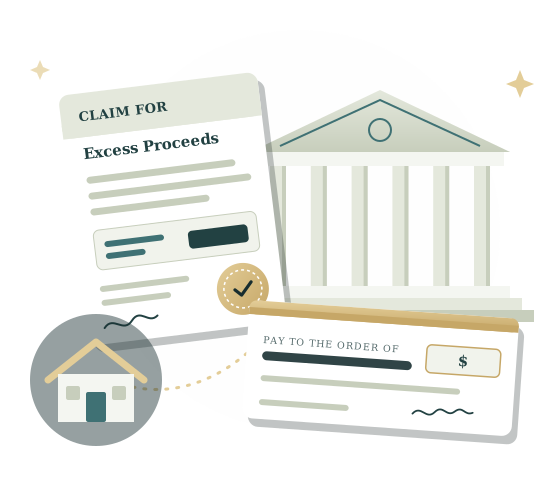
When a property sells at foreclosure or tax sale for more than what was owed, the difference belongs to the former owner or their heirs — not the buyer, not the lender, not the county. We help you claim it.
You pay nothing unless we recover your money. Our fee is never more than 30% of what we collect, plus costs — and you will see your number in writing before you sign.
- $0 upfrontNothing owed if nothing is recovered.
- 30% maximumNever more, sometimes less, in dollars before you sign.
- Licensed attorneyEngaged by us to file and argue your claim.
- Since 2021A Texas firm working from the public record.
What is a surplus?
The money the county is holding
Say you owed $40,000 on your property and it sold at auction for $105,000. The debt gets paid, the costs and fees get paid, and what’s left over sits with the court or the county. Depending on where you are, it’s called a surplus, an overage, or excess proceeds.
In most states, that money belongs to whoever owned the property when it sold, or to their heirs. But it does not come to you automatically. Someone has to file a claim, prove who’s entitled to it, and do it before the deadline runs out.
That’s the part we handle.
Where $105,000 goes
The example above, drawn to scale.
- The debt is paid first, to the lender or the taxing units.
- Costs and fees of the sale are paid next.
- What’s left over is held by the court or the county until someone entitled to it files a claim.
Plainly stated
What we do, and what we are not
What we do
- Identify surplus funds held after a foreclosure or tax sale
- Verify from the public county record who is entitled to them
- Locate and assemble the documentation a claim requires — deed history, tax records, probate and heirship paperwork
- Engage a licensed attorney to file and argue the claim
- Track the filing deadline
- Follow the case through to disbursement
What we are not
- Not a law firm. We coordinate with a licensed attorney; we do not practice law.
- Not a government agency, and not affiliated with any county, court, or lender.
- Not a buyer. We do not purchase your property, your claim, or your interest in it.
- Not taking title to anything you own.
- Not a custodian of your money in the sense of keeping it. Under the agreement the recovery is received by us first. We notify you, send you a copy of the check, and give you a written accounting of costs and fees. You then confirm in writing how the payment should be made out and where it goes.
What you receive
When you engage us, this is what you get
Seven things, in writing
Each one is part of the service. None of them is billed to you up front.
A written case review
Before you commit to anything — which sale, which fund, how much is being held, who we believe is entitled to it, and the deadline.
Record retrieval
We pull the deed history, tax records, sale documentation and, where a claim runs through an estate, the probate and heirship records.
A licensed attorney
Engaged to file and argue your claim. We select and retain counsel, and we advance the fee. The attorney’s duties of confidentiality, loyalty, and independent judgment run to you.
Filing and court costs advanced by us
Reimbursed from the recovery. Nothing is asked of you up front, and nothing is owed if the claim fails.
Deadline tracking
So nothing lapses while the file is with us.
One point of contact
And a status update at every stage.
Follow-through to disbursement
We don’t close the file when the paperwork is filed. We close it when you’re paid.
Four steps
How it works
From the first letter to the day the funds are released.
- Step 1
We contact you, or you contact us.
If a letter or text from us is how you found this page: we’ll tell you exactly which property and which sale we’re calling about, and where in the public record we found it. If you came here on your own, tell us the address and we’ll look.
- Step 2
Free case review.
We tell you what we found, what we think is recoverable, and what the deadline is. This costs nothing and puts you under no obligation. You will know your fee — the actual percentage, in writing — before you are asked to sign anything.
- Step 3
You decide.
If you want us on it, you sign the fee agreement. If you don’t, that’s the end of it and you owe nothing. Take the agreement home and read it — we would rather you did.
- Step 4
We file, and we follow it through.
The attorney files the claim. We track it, respond to the court, and stay on it until the funds are released. Typical timeline: 2 to 5 months.
Got a letter or a text from us?
We’ll tell you exactly which property and which sale we’re calling about, and where in the public record we found it. Why you got a letter from us
What it costs
You pay nothing unless we recover your money
If we recover nothing, you owe nothing. Not our time, not the costs, not the attorney. We advance all of it and we absorb it if the claim fails.
If we do recover, it works like this:
Costs actually paid to third parties come off the top — postage, delivery, notary fees, and the attorney’s fees and costs where an attorney is retained. We advance them; they are reimbursed out of the amount recovered.
Of what remains, our fee is never more than 30%. Thirty percent is our ceiling, not our starting point — on some matters the rate is lower, and it is negotiable. Whatever number applies to you is written into the agreement before you sign, in dollars and not just as a percentage.
Your rights
Things we would rather you hear from us
A claim takes more than a form
Deed history, tax and sale records, probate and heirship paperwork, a court filing, and a deadline that does not move. We handle every step, and we advance every cost until your money is recovered.
The fee is a term, not a law of nature
Thirty percent is the most we charge, and on some matters it is negotiable downward. Ask. Anyone who tells you their rate is fixed and non-discussable is telling you about their sales process, not about your claim.
Finding out is free
You should not have to pay anyone to find out whether money is being held for you. Our case review costs nothing and obligates you to nothing.
There is a deadline
In Texas, a claim for excess proceeds from a tax sale generally has to be filed within two years of the sale. After that the funds are distributed to the taxing units. Foreclosure surpluses follow different rules, and your written case review gives the deadline for your sale.
No one legitimate will ask for this
No one legitimate will ask you for a wire to a personal account, a gift card, or your Social Security number before there is a signed agreement in place.
“Sign today” is pressure
If someone tells you the claim is lost unless you sign today, that is pressure, not information. The deadline is real; the urgency is manufactured.
Cancellation
Before you sign, and after
You can walk away at any time, for any reason, at no cost. The case review is free and obligates you to nothing.
The agreement makes us your exclusive agent on the claim, and it sets short response deadlines. Read what signing actually commits you to before you sign, not after.
We would rather you take the agreement, read it, sleep on it, and call us tomorrow.
Questions
The objections, answered flatly
Is this a scam?
It is the right question to ask. A legitimate recovery firm does not ask you for money before a recovery, does not ask you to sign over your property or your claim, and will tell you which sale and which fund it is talking about so you can check it yourself. We do all three. You can call the county or district clerk directly and confirm what we tell you. We encourage it.
How did you get my information?
From the public record. Foreclosure and tax sale results, and the excess proceeds held after them, are public documents. We read the same records anyone can request. Nothing came from a credit bureau, a bank, or a purchased list.
Why should I work with you?
Because a claim takes records, an attorney, filing costs, and someone watching the deadline. We handle all of it, we advance every cost, and we stay on the file until you’re paid. You pay nothing unless we recover your money.
What happens if you don’t recover anything?
You owe nothing. Not our time, not the costs, not the attorney. We advance all of it and we absorb it if the claim fails.
How long does it take?
Typically 2 to 5 months from filing to release of the funds. The court or the county sets the pace, and claims that run through an estate can take longer.
Check my case
Tell us the address. We look it up in the public record and send you a written case review. It is free and obligates you to nothing.
Start a case
Tell us the address. We’ll look.
We check the public record for your sale and send you a written case review: which sale, which fund, how much is being held, who we believe is entitled to it, and the deadline. It costs nothing and puts you under no obligation.
- Call936-287-1001
- Office8503 Magna St, Houston, TX 77093